
On February 1, 1965, I was arrested in Selma, Alabama with Dr. Martin Luther King and 250 others. Here’s what happened that day, and how I ended up eating Dr. King’s dinner.
I – Blocking the View, Blocking the Road
 That morning, I was too tense to eat. Keyed up and ready, my thoughts were full of armies marching to battle.
It was February 1, 1965. I was part of a nonviolent “army” – or at least a battalion – set to march in Selma, Alabama that day. Our objective, the territory we hoped to occupy, was downtown, the Dallas County jail; we planned to capture it by getting arrested.
I had been in Selma less than a month. Perhaps because I was raised on military bases, comparing the movement to an army came easily to me: Dr. King was the general; I, white and fresh from college in Colorado, was a private, a grunt.
Although our commander had just been awarded the Nobel Peace Prize, his ragtag force was ready for combat and bent on conquest. For us, victory meant nothing less than the overthrow of centuries of black exclusion from public office, the ballot, and the jury box in most of the American South.
Of course, the military parallel is wildly inexact: for one thing, we aimed at a bloodless coup; more mundanely, even in 1965 a real army private earned considerably more than my pittance of $25 per week. One didn’t join the movement to carry a gun, or get rich.
On the other hand, the comparison was not wholly fanciful; after all, both groups demanded real discipline, and suffered real casualties.
Our ostensible destination that morning was the Dallas County Courthouse downtown, to renew a demand that the county voting rolls be opened to all its citizens. No one expected to get that far, however. Everybody knew we wanted to provoke arrests: the staff knew it, black Selmians knew it.

The cops knew it too; and presumably the Klan, along with some of the people who kept sending Dr. King death threats, threats that came in practically every day, by mail, phone, and other media. I had seen a few of the threatening letters, and knew that many of them were quite credible.

In the years since Dr. King’s murder, I have been bemusedly tolerant of the plethora of conspiracy theories offered in explanation, tending to believe and disbelieve them all, in equal measure. The CIA? The Klan? The Mafia? A redneck hit squad? A lone bigot?
All are plausible. Yet I’m evenhandedly skeptical too, because while one of the conspiracies finally succeeded, I know well enough that there were numerous others which were foiled only by chance, by timely police intervention, or –
– or, well, because someone like me was walking near Dr. King at just the right moment, and blocked a sniper’s aim.
That was one of my early tasks as a rookie civil rights worker: to stay close to Dr. King when we filed through the Selma streets. There were three or four of us who shared this duty, and we kept him pretty much surrounded.
We were the point men, his bodyguards. Unarmed, of course, and in my case at least, no great physical threat to any direct assailant. But without weapons and muscle, how were we supposed to provide protection?
Simple: our bodies were visual obstructions, blocking the aim of any sniper crouched on nearby rooftops, trying to draw a bead on Dr. King through the scope of a high-powered rifle.
The job was explained to me by big James Orange, who had been around the movement a lot longer. I grasped its function at once. But I also had a question: What if the sniper fired anyway, hoping for a lucky shot, and hit me instead?
James Orange answered my query first with a characteristically broad, hearty grin. Then he shrugged, slapped me on the shoulder and said, “Hey, don’t worry about it, Chuck. If you get killed, we promise – Dr. King will preach at your funeral!”
“ Hey, thanks, Jim,” I retorted, “that makes me feel so much better.” But the comeback took a couple seconds longer to come up with than I wanted.

(Five years later, researching my book Selma 1965, I found references to a police report which said that on one of our marches there very likely was a rifleman on a rooftop, poised to do just what I was there to prevent. Dr. King, it turned out, learned of this much sooner; he had spoken calmly about it to reporters a few days later. Reading in a quiet library about the report made the hairs on the back of my neck stand up. But I wasn’t really surprised.)
Barely nibbling breakfast that morning, frightened and exhilarated at the same time, I donned my movement uniform: still-stiff denim overalls, a matching jacket and, incongruously, a yarmulke. Another staff member, who understood the importance of Jewish support to the movement, had passed them out to us not long before. Knowing little about either Judaism or black Baptist Christianity, it was all the same to me. Properly decked out, I headed across town for Brown Chapel AME Church.
Brown Chapel was red brick, with two squat steeples. It sat on Sylvan Street in the middle of the George Washington Carver Homes, Selma’s neat, generally well-kept black housing project. People were milling around on the steps, and inside the benches were full.
There was a “mass meeting” underway, led by various key staffers, to get everybody into the right frame of mind for the day’s events. Even at that early hour of the morning, the crowd was ready; and the intensity and fervor of such meetings are beyond my powers to describe.
The elements were basic and familiar: preaching, praying, singing, clapping; but the combination, in those days, in that place, produced an uplifting energy that was unique, unforgettable, and overwhelming. I have known nothing quite like it, before or since.
Our marching orders were boomed from the pulpit, along with reminders of the need for strict nonviolent discipline, and reassurances that going to jail or being hurt in the cause of justice was nothing to be ashamed of. There was tension in the church, because we knew anything could happen; but there wasn’t the cold fear I knew on other days, when violence hung in the air like heavy mist.
After a concluding prayer and a round of “We Shall Overcome,” we were soon lining up outside, watching our breath in the chilly morning air, then stepping off, clapping and singing, headed up Sylvan Street toward the courthouse, about ten blocks away.
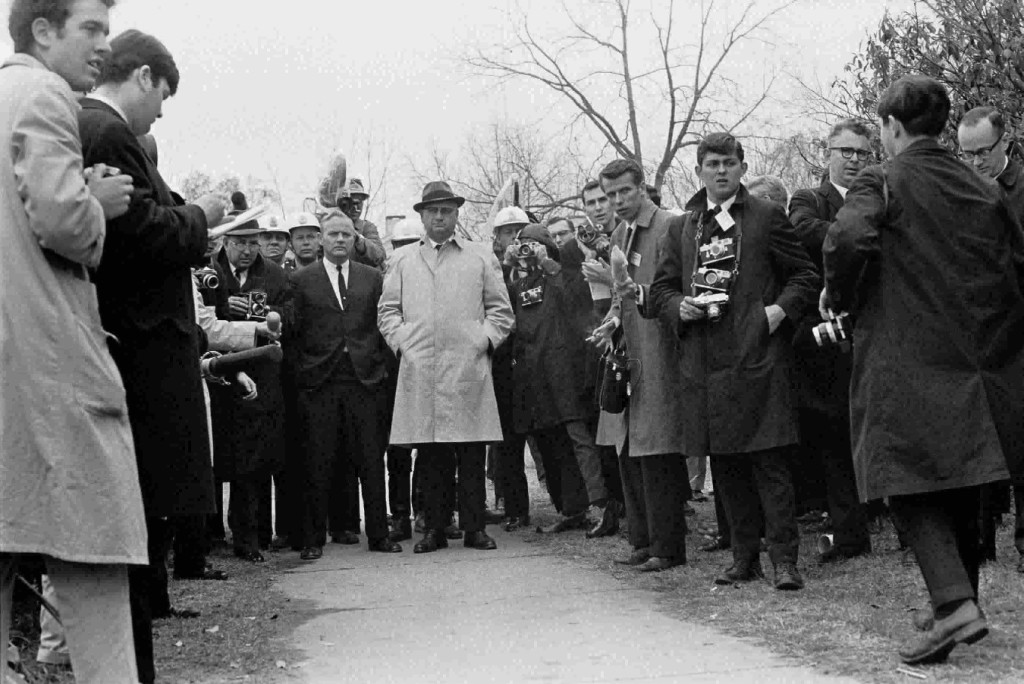
As planned, I ended up near Dr. King, at the head of the column. We hadn’t gone far, barely a block, before we were stopped by a white man in a light raincoat and a fedora hat, standing in the middle of the street with his hands in his pockets.
II – The Clash of the Titans
Baker was a good and smart man, a worthy opponent to Dr. King. If we had faced him alone in Selma, it’s a fair guess that he would have routed us.
Baker would have beat the movement not with force, but with brains. He was a disciple of Police Chief Laurie Pritchett, his counterpart in Albany, Georgia, who had outsmarted and outmaneuvered a vigorous protest campaign there three years earlier.
Albany’s movement had had everything: marches, protests, new freedom songs, and many arrests. Dr. King had come too, and even faced jail. But in the movement’s still-fresh folklore, Albany was the archetype of disaster.
This was because Laurie Pritchett had figured out how to handle the pack of Yankee reporters who showed up wherever Dr. King entered the fray. Told of a crisis bedewing, they swarmed into southern towns with their cameras, microphones, notebooks and expectations. Above all, they expected to see crude redneck cops and club-wielding sheriffs beating up and brutalizing peaceable, noble Negroes.
Pritchett understood the reporters’ stereotypes, and was careful not to reinforce them. Instead, he spoke politely to the reporters, and made sure that when his police arrested the marchers, they did so quietly and without fanfare. (There were, of course, stories of beatings inside the jail. But those happened out of sight; Pritchett stoutly denied them, and the allegations could not be confirmed.) Instead of officially-sponsored mayhem, what Pritchett served up looked like a model of seemingly civilized southern restraint, upholding law and order against a disorderly crowd of black insurgents.

Pritchett’s strategy succeeded brilliantly, on two fronts: with no exciting violence to film and write about, the Yankee reporters were thrown off-stride. They quickly became bored, and moved on to some other, more exciting event. As they did so, the divisions in the local black community – there were always divisions in local black communities – flared up into recriminations and sapped the movement’s morale and momentum.
The defeat of the Albany campaign made Pritchett something of a hero to many southern officials. He traveled the region giving speeches about how he had whipped the agitators and sent Dr. King packing.
Among his hearers, none had been more attentive than Selma’s Wilson Baker.
Baker had the Pritchett mild-mannered demeanor cold, right down to the non-threatening title of Public Safety Director he had chosen himself, and his civilian-style suit and fedora, which matched and blended with Dr. King’s typical attire.
As the march approached, it was evident that if King was now determined to get arrested, Baker was ready to accommodate him – but he would also make sure that the crowd of reporters hovering and getting chilled, saw nothing more exciting in the process than a lot of colored people milling around outside the back entrance to the three-story City Hall, where the city and county jails occupied the upstairs floors.
Yet Dr. King had learned from Albany too, and he planned both to outmaneuver Baker and use him at the same time. He wanted Baker to make the arrests, because King would feel safer in Baker’s city jail. And at the same time, Baker’s own restraint, however successful with the Yankee media, would work against him with a crucial local constituency.
Selma, fortunately for us, was not Albany. Here, for all his outward composure, Baker lacked Laurie Pritchett’s control of the situation in white Selma, as we knew well enough. In particular, Baker couldn’t afford to let us get past him to the courthouse, because his rival, Dallas County Sheriff, Jim Clark, was waiting there.

Sheriff Clark was a walking stereotype: a tough-talking, head-cracking Deep South lawman, who had no patience with civil rights protests, or with Baker’s “coddling” of agitators. Further, besides his deputies, Clark was backed by a volunteer posse. The posse had first earned notoriety for helping beat up and banish labor organizers in various parts of this so-called “right to work” state. Just the year before, they had been turned loose on earlier civil rights marches, with predictably bloody results. But Dr. King wasn’t there then, and the beatings attracted only minor outside notice.
All of us who were marching had seen the possemen on earlier days, hefting long unpainted homemade billy clubs, and looking anxious to get at us. Their uniform consisted mainly of various shades of ill-fitting khaki work clothes, and white plastic hard hats bearing small metallic foil “Posse” stickers. Most possemen also had a large pistol hanging from one hip, and an electric cattle prod dangling from the other. These latter were battery-filled cylinders, like overlong flashlights, with metal prongs at one end. The cattle prods produced a nasty shock; the longest ones were said to sear bare flesh.
No question about it: the posse looked feral and dangerous. Compared to them, Baker’s black-uniformed policemen seemed like pillars of professional restraint, protecting us from the sheriff’s troops more than they were protecting white Selma from us.

When Clark and the posse broke up the marches a year earlier, they had gotten away with it. Then in November, 1964 a young appliance salesman named Joe Smitherman won a very close mayoral election, promising to bring in new industries and jobs. But Northern companies weren’t interested in Clark’s version of law and order, so Smitherman hired Baker to polish up the town’s image.
Ever since, Baker and Clark had been jockeying for control of the city’s streets and image. When Dr. King announced his plans to come to Selma, their struggle was ratcheted up several notches.
With the usual retinue of reporters and cameras in his wake, Dr. King had been playing on this tension and planned to raise it carefully but relentlessly to a fever pitch. That struggle would keep the Yankee press interested, and maintain movement solidarity. The fact that on this February morning the tension between the two law enforcement units was almost palpable suggested that Dr. King’s plan was working at least as well as Baker’s
Our earlier marches had stayed on the sidewalks. This time, though, we were proceeding brazenly down the middle of Sylvan Street. That made us a parade, and a parade without a permit. Baker couldn’t ignore this challenge. It would look to Clark’s supporters as if he was giving in to the country’s most notorious agitator, and bolster the sheriff’s contention that white Selma was being sold out to lawless black invaders.
Baker followed the script, testily reminding Dr. King that he didn’t have a permit, and warned that if we didn’t return to the sidewalk immediately, he’d have to arrest us.
Taking his cue, Dr. King quietly demurred. Baker stepped aside, and we resumed walking. Two blocks up, we turned the corner at Alabama Avenue. Ahead lay City Hall, and a few blocks further south, the courthouse.
But this was as far as we could be allowed to go. Black-uniformed police fanned out across the street ahead of us, and Baker drove up, got out of his patrol car and announced our arrest.
Dr. King asked if we could pause for a prayer, and we all knelt on the cold, nubbly asphalt.
Everything was going like clockwork.
III – The First “Quaker-Type” Meeting
There were about 250 of us in the march, and it took hours to book us. The police herded us into the parking lot behind City Hall, and we stood there shivering in the cold, waiting our turn to go inside.
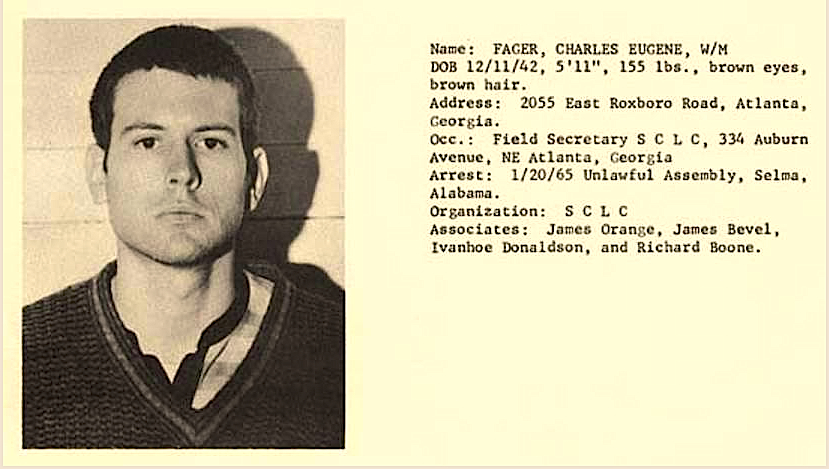
Eventually I was led in, fingerprinted and had a mug shot taken. Then I filed upstairs to the third floor, to what I now learned was the county jail. The city jail, too small to hold us all, was on the second floor.
Here the cells ran along two walls; above them, out of reach, was a row of small windows. Across from the cell block was a large day room, bare except for a couple of steel tables bolted to the floor, and a toilet in the corner. The marchers were crowded in the day room, and I moved in to join them.
There wasn’t much for us to do but mill around, talk, and try to rest on the steel floor. We were all waiting for Dr. King to arrive, and tell us what to do next.
Finally, after what seemed hours, he and his right hand man, Ralph Abernathy, appeared. Later we found out that Wilson Baker had kept them till last, hoping they would decide not to be arrested after all. We greeted Dr. King with applause, expecting something like a resumption of the mass meetings at Brown Chapel.
But Dr. King was very subdued. He told us he was feeling hoarse, and would rather not preach. He suggested, instead, that we have “a Quaker-type meeting,” in which people would speak simply “as the spirit moved,” and he would listen along with the rest.
This was the first “Quaker-type meeting” I was ever part of, and it was like none of the thousand-plus Friends meetings I have attended since becoming involved with Quakers a year or so later.
It was, for one thing, much noisier. The spirit not only moved some of us to preach that afternoon; it also moved all of us to sing, several times, both freedom songs which I knew and gospel hymns which I didn’t.
Being in jail added a special intensity to our voices and rhythmic accompaniment; the result was more than just music. Those of us pressed up against the walls soon found that if we slapped them in rhythm, they resounded like muffled calypso drums.
When enough of us did it, the whole floor began to vibrate, as if the building itself was rocking and reverberating in time with us. And perhaps it was, because through the walls we soon heard an answering chorus from the other end of the third floor, where the women were being held. How I wish someone had recorded us!
Another intriguing feature of this meeting was that, notwithstanding Dr. King’s invitation to anyone so moved to speak, the spirit nonetheless seemed to move rather directly and carefully down the local status hierarchy, until all the local dignitaries and preachers among us had had their say. Finally ordinary folks chimed in, and I even spoke up at one point, though I can’t recall my message.
This meeting also went on longer than any “regular” Quaker meeting; two to three hours, it seemed. But finally, after one more heartfelt chorus of “We Shall Overcome,” sung in muffled, echoed harmony with the women in their cell block, the meeting finally broke up, and we sank into a happy, exhausted disorder within the confines of our pen. Glancing up, I noticed that the windows above us had all been steamed over by our lusty exhalations.
As the group relaxed, Dr. King reverted to his pastoral role, and began moving along the edges of the day room, speaking through the bars to the regular county prisoners in their cells. Our coming had deprived them of access to the day room and the little chance to stretch that they had. Dr. King talked with each of them, listening sympathetically to their tales of woe and injustice, which carried a special poignancy on this afternoon.
He was still, I think, making these rounds when there was a clanging at the far end of the cell block, and the heavy barred door suddenly rolled back a few feet. We turned at the noise, and recognized Sheriff Clark’s grim visage.
 His eyes swept over the group, and then he began pointing and calling out: “You – King. Abernathy. Over here.”
He peered some more and pointed again, first at another staff worker. Then he pointed at me. “You.”
All at once I felt cold. It was safe in that crowded day room. Where would they take us now? We had all heard stories of people who disappeared from southern jails, never to be seen again, unless to turn up floating in the river.
I moved reluctantly toward the door, aware of the suddenly sober expressions on the faces of the men I passed.
IV – What’s Gandhi Got To Do With It?
In the hallway the sheriff said gruffly, “Follow me.”
We did, down the stairs.
Emerging on the second floor, we were led to a cell in the city jail. In it were two sets of steel bunk beds, and another small window up high. The door rattled shut behind us, and Clark retreated back to his own turf somewhere else in the building.
Then I understood. Clark was removing the “leadership” from the group upstairs, isolating the local men from the “professional agitators,” in hopes of maintaining better control over the rest.
The realization made me smile. It was flattering to be included among those who threatened his status quo. But it was also a stretch. True, I was indeed a “professional,” with minuscule paychecks to prove it; and certainly I was an outsider, but one still just beginning to find my way around in a bewildering new world. A “civil rights agitator”? Hardly.
Oh well. I took this implicit designation as a compliment. In any event, there in the cell I was as close as I had ever been to Dr. King, without dozens or hundreds of other people around as well. I began to hope there might be a chance to talk one-on-one, get to know him better, and maybe become better known to him as well.
Nothing like this happened immediately, however. Dr. King was not only hoarse, he was also bone tired, as he usually was in those days. After some quiet huddling with Abernathy, he soon lay down on one of the bunks and dozed off.
I was too excited to follow his example, even though I’d been up early and it was now late afternoon. The winter daylight was turning gray in the slit of the small high window. I noticed how quiet the cell was.
Then I also noticed the growling in my stomach. I hadn’t eaten much breakfast, the march and waiting had taken hours, and no one had brought lunch to our shouting, singing crowd upstairs. In fact, I was starved. Would they bring us anything here?
After another hour or so, when the cell was dim in the dusk, there was a sudden noise in the hallway outside. A door banged, a light went on in the hallway, and metallic wheels squealed. A pungent aroma floated toward us as a voice called, “Dr. King! Oh, Dr. King! Ah got dinner for Dr. King!”
I turned to the cell door. Behind me Dr. King stirred.
A trusty appeared, a dark specter in kitchen whites, pushing a cart. “Dinner,” he repeated. “Ah got dinner for Dr. King.” I looked at the cart and identified the aroma.
Collard greens. A single plate, piled with a mound of them, sat in the center of the cart. Were they steaming, or was it only my imagination?
I had never heard of, never mind eaten collard greens before coming to the South a few months earlier. But by now I knew them to be a humble southern vegetable, found in the more modest homes and establishments. Their odor was strong, the taste faintly bitter, though it mellowed somewhat after long simmering with chunks of fatback pork and salt. While collards were said to be very nutritious, I had not liked them much.
But now they looked succulent, and their fragrance set my mouth to watering.
The trusty had stopped, almost right in front of me. “Dr. King?” he called one more time, tentatively.
 I heard motion from the bunks. Dr. King came past and reached through the bars to shake the trusty’s hand. “How you doin’?” he asked, with a smile that was almost a grin, ready to make some small talk. “What you got there?”
I tuned out their quiet banter. My attention was drawn magnetically back to that steaming plate. As I gazed, it seemed to grow in size, til it looked as big as a platter, large enough to feed all of us in the cell, with some left over.
But I knew this was illusion. It was merely a plate, and only one, and it was meant for Dr. King.
I reflected on this melancholy fact, then told myself sternly to buck up. The image of the army came back: Dr. King was the general, I was the private. Armies win wars as much by the quality of their generalship as by the courage and luck of their grunts. Maybe more.
In our army there were 250 others like me upstairs, and many more than that outside, in the dark and edgy town. But there was only one of Dr. King, and even here he could still think, plan and give orders. It was, I considered, essential that he have a clear head, to calculate our next pivotal tactical and strategic moves. Thus it was quite proper that he maintain the energy and vigor needed to face whatever awaited him here in this jail, as well as the many hazards hovering beyond it.
So what if I was I hungry, even ravenous? I was young, relatively strong, temporarily out of action and in any case expendable. I could wait, while Dr. King did what was needed.
My gaze wandered back to the trusty. There I saw consternation was now woven into the creases of his weathered face, and began to listen again, as Dr. King said,
“– And that, my friend, is why I cannot eat your greens. I’m sorry.”
What?
I peered at Dr. King. Was he sick? Had I heard wrong? What had I missed? The trusty came to my rescue.
“Say what?” he murmured, as if he hadn’t heard it either.
In reply, Dr. King began to explain.
The exact words are gone now, but the substance of what became a discourse is still as clear as if it were yesterday:
“You see,” Dr. King began, “not long after I got involved in the mov-e-ment [he always said the word as if it had three syllables: “move”– an unvocalized “ah”– “ment”], I had the opportunity, with the help of the Quakers, to visit India and study the work of Mahatma Gandhi, who had freed his country from British rule through campaigns of nonviolent resistance.”
The trusty’s face added a frown of incomprehension to the furrows of confusion. I got the distinct impression he had no idea who Mahatma Gandhi was; for that matter, I barely did myself.
“And we found that Gandhi had gone to jail many times, sometimes spending long periods in prison with many of his followers. After he had been in prison only a few times, Gandhi decided it was important to make the time count.
“So when he was in prison with a large number of people, he would organize them into a small representative democracy. ‘We Indians say we want to be free and rule ourselves,’ he told them. ‘But if we are ever to make that happen, we need to learn and practice the tools of representative government.’ So they held mock elections and practiced parliamentary procedure and all that.”
I stole another look at the plate. Were the greens cooling? Did the trusty know what “parliamentary procedure” was?
“But that was not all,” Dr. King went on. “Many Indians were illiterate, and so Gandhi asked those who could read to teach those who could not. And others who knew trades like carpentry, or professions like law and medicine, held classes to teach their fellows about practical skills and legal rights. Gandhi turned the British prisons into great schools of independence, right under the government’s nose.”
The trusty rubbed his chin and blinked. Was he, like me, wondering what any of this had to do with collard greens?
“Gandhi also worked to make the time in prison a unifying experience culturally,” Dr. King explained. “In India there were two great religions, Hinduism and Islam, and the British schemed ceaselessly” [again the almost measured beats: “cease..less…ly”] “to sow discord and conflict between them, with much success.
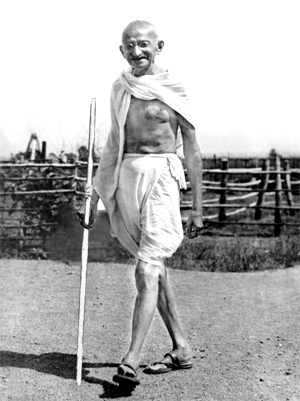 “So Gandhi worked to heal these divisions, by holding religious services in prison every day. He used both Hindu scriptures and the Muslim Koran, showing respect and even reverence for these two ancient traditions. It had some success while Gandhi was alive.”
I glanced at Dr. King. There was a smile on his broad face; he had warmed to his subject.
“And not least,” he said, “Gandhi decided that imprisonment was to be for him a time of religious retreat, with a regular routine of spiritual meditation and practice, to free and purify his spirit while he worked to free and purify his country.”
Dr. King spread his hands out between the bars, gesturing as if in a pulpit. “I was very moved by what I learned in India,” he said, “and when Dr. Abernathy and I realized that we were likely to face arrest and jail repeatedly in our own struggle here, we agreed that we would follow Gandhi’s example, to the extent that we were able.”
Did this, I wonder, mean a literacy class in the morning? Or readings from the Koran? The trusty looked equally confused.
“Long ago,” Dr. King resumed, and it sounded as if he was winding toward some kind of punch line, “Dr. Abernathy and I resolved that whenever we went to jail, we would try to be placed together, and together we too would make our prison sentences times of spiritual retreat and religious refreshment, with a regular routine of prayer, meditation and study.”
Not to mention, I thought, some preaching now and again.
“And to put ourselves into the proper frame of mind for these times of retreat,” Dr. King concluded, “we have always made it our practice that for the first two days we are in jail, we will fast.”
V – Conclusion
So there it was, finally.
As I say, these were not his exact words, but the cadence and content are all there. In any case, when the trusty heard the word “fast,” his mouth dropped open. Mine did, too.
The trusty frowned more deeply, and turned his head slightly, as if he was working up to ask a question, perhaps something like, “Say what?” Dr. King headed him off.
“And that, my friend, is why I very much appreciate the effort you’ve gone to,” he said, “but I’m afraid I am unable to eat your greens.”
“You mean – ?” croaked the trusty. Much of the rest of the disquisition may have gone over his head, but this last was sinking in.
Dr. King nodded.
The trusty looked genuinely confused.”You mean,’ he repeated, “you can’t – ?”
Now Dr. King shook his head slowly.
The trusty looked at Abernathy, who had moved to Dr. King’s elbow. He smiled apologetically, but shook his head also.
The trusty blinked and turned toward the other staffer, who had hung back silently through this whole exchange. His head shook too.
The trusty stood there for a moment, without a clue as to what to do next.
And then, he looked at me.
In the parable of the Good Samaritan, I have always thought the key to the story is in verse 33 of Luke’s Gospel’s tenth chapter, where it says of the Samaritan who found the robbery victim, wounded and abandoned in the ditch, that “his heart was moved with compassion.”
I think I can say, with some humility, that when I saw the sense of loss and confusion on the trusty’s face, my heart, like that of the Samaritan, was moved with compassion. (Or if not the heart, then an organ just under it.)
After all, it was easy to imagine what kind of life this man had, standing by the squeaky cart in the worn white uniform of a kitchen helper. We had heard similar laments from the county prisoners upstairs. I guessed he was probably a habitual drunk, petty thief, or some combination of the two.
He probably had no job, like so many other black men around Selma, or couldn’t keep one; perhaps he was among the many farm laborers who had been pushed out of the cotton fields by mechanization. Not dangerous, probably, except to himself or when drunk. Otherwise, why would the police have let him work in the kitchen, where there must be knives and other potential weapons?
This was his bleak present, and probably his dreary future: helping prepare the Spartan prison fare for men, and perhaps a few women, slightly more wretched than himself, all wasting their lives in the obscure cells of a provincial city jail.

And then, like a breath of the divine, this day brought an astounding break in this routine: a flood of respectable citizens into the cellblocks; our thundering, rhythmic chorus of defiance and spirit which must have reverberated through these halls as well as our crowded warren upstairs.
Even more amazing, from out of this inchoately marvelous mass, emerged the modern Moses, Dr. Martin Luther King, Jr., freshly back from Oslo and the Nobel Peace Prize, right into the hallways of his own tiny, godforsaken wasteland.
Why wouldn’t he want to seize this moment of light, this trembling interval of grace, and do something, do his best, for this apparition? I had heard about the anguished letters Dr. King received from black people across the country, people who thought he could work wonders, cure their diseases, or those of their suffering children, just by the laying on of his hands.
The trusty, though, had made no request, had asked for nothing. Rather, he had exercised his meager skill, and probably coaxed and begged his white keepers for leave, this once, this only once, to do for Moses the little he could do, bring to him a token of gratitude and honor, a sign of the exaltation that Dr. King, though all-too-human, had had laid on him for the benefit of us all, and especially for the least of them, of whom this trusty was a fitting embodiment.
He had made Dr. King a plate of greens.
And now Dr. King had gently, but firmly, refused it. What were homilies about someone named Gandhi compared to this?
How could I not be moved by this spectacle?
How could I not, in the face of it, make my own gesture, my own sacrifice?
I spoke:
“Um,” I said, “you know, I’m really kind of new to this nonviolence business, and I never heard all this stuff about Gandhi before. So I – well, I haven’t made any vows about fasting or praying or, um, anything like that.”
The trusty blinked and listened to me bungle my sentences.
“So,” I stumbled on, “what I mean is – I’d hate to see you go back to the kitchen , um, [not] empty-handed, as it were.”
I was losing him. “What I really mean is,” I said, trying to get the lead out, “I mean, if it’s all right with you, and Dr. King, well – I-I guess I’d be willing, um, — willing to eat your greens.”
The trusty blinked at me again. His gaze shifted questioningly to Dr. King. I followed, half afraid to look. But we both saw Dr. King give a slight nod and shrug, as if to affirm the innocence of my ignorance.
The trusty then looked at Abernathy, who nodded as well; the other civil rights worker followed.
Thus confirmed in the awareness that I was his fourth choice, I watched him slowly pick up the plate. He balanced it carefully, so as not to spill the collards’ copious pot liquor, deftly opened the narrow slot in the door with the other hand, and slid it through. The plate was still warm in my hands. He passed me a plastic fork and knife.
I half-turned away from the others, all too conscious of their eyes on me. I was almost ready to cry out: oh god, forgive me! But the greens looked so good, the smell was intoxicating, irresistible. I jabbed the fork into the heaped greens.
But the tines sank only half an inch before sticking in something firmer, almost solid.
What the –? Suspicion welled up. Could there be something sinister hidden in the chlorophyll? I scraped the greens to one side.
And there, beneath the facade of dull green, was not some toxin, nor another vegetable. Instead I found meat. Thick pink slices of fine country ham, a food of shameless luxury.
My mind raced as I cut and wolfed the chunks. This could not possibly be the everyday menu in this establishment; what cunning had he exercised to get them? The concealing arrangement of greens, which had seemed so random, suddenly took on an aspect almost of art.
What a dinner I had that night. It has nourished me ever since.
Postscript, 2018: For nearly fifty years, the story of Selma had a happy ending; as a result of the people’s struggle there, the Voting Rights act was passed. Its impact brought real change to America: millions of nonwhites were able to vote; new black leaders were elected to any offices, and exercised real political power. The elections of three American presidents (Carter, Clinton & Obama) were made possible by the Act.
But then in 2013 the Supreme Court struck down a key provision of the Act, deeming it “no longer necessary; and rolling back the actual voting rights of people of color began immediately, and hasn’t stopped.
The Voting Rights Act is not completely gone — it was black votes that kept Roy Moore out of the Senate in the recent Alabama election. But the “happy ending” to my story here has been largely erased. The struggle is on again, and the generation who wrote it wit their courage and suffering is passing away.
So especially for younger readers, the “moral of this story” now is:
Step up, because it’s YOUR turn.
– – – – – – – – –
Adapted from: Eating Dr. King’s Dinner, A Memoir of the Movement, 1965-1966. Copyright (c) Kimo Press, 2005.
Available online at Amazon in paperback or Kindle

– – – – – – –
Thanks for sharing this, Chuck. I find it very moving.
Thanks for this on-site account of the march into Selma. You were incredibly brave. You have walked ” where angels fear to tread.” I loved that some of you still kept your sense of humor– like the comment that James Orange made that if you got killed, King would be preaching at your funeral. Thank you for what you all did.
Chuck, for the benefit of those of us who are too young to remember this era, what was the point of handing out yarmulkes? Was it to encourage Jewish support for the movement, or to indicate Jewish support the movement already enjoyed? It just seems an odd thing to do.